HDFN is a serious diagnosis, but it’s also becoming more and more treatable. Let’s review the essentials together!
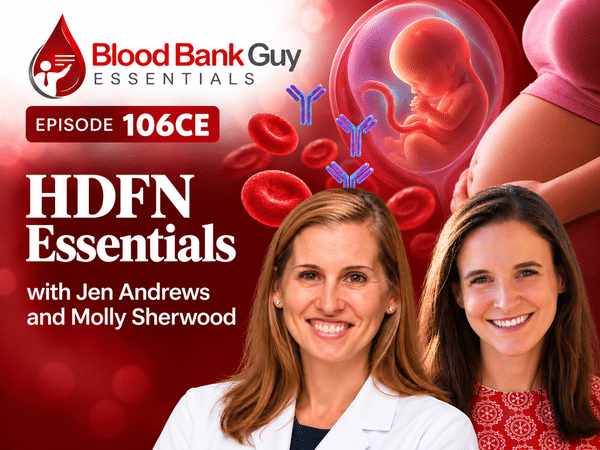
CE episode! Hemolytic disease of the fetus and newborn (HDFN) feels intimidating to learners because of its locationat the intersection of blood banking, obstetrics, maternal-fetal medicine, and pediatrics. In this episode, Dr. Jen Andrews and Molly Sherwood have lots of thoughts and ideas to make this complex topic much more approachable. Jen, a pediatric hematologist and transfusion medicine specialist, shares her first-hand experience with both caring for babies affected by HDFN and managing alloantibodies as a blood banker. Molly has great insight from both her research leadership at the Allo Hope Foundation as well as her unique perspective as a mother with maternal alloimmunization.
Jen and Molly walk us through how maternal red cell antibodies can affect a fetus, the most common ways sensitization can occur, and how testing has expanded and improved in recent years. They outline especially the roles of noninvasive pregnancy testing (NIPT, sometimes called “cell-free fetal DNA” testing) as well as how baby’s blood flow in the middle cerebral artery (MCA) by Doppler ultrasound has had amazing effects! We also discuss antibody titers and how to use them, Rh immune globulin, and why antibodies against Kell system antigens (like anti-K) can be especially concerning. Finally, we shift our eyes toward the future and look at efforts to improve recognition of mothers who might become alloimmunized, the importance of coordinated multidisciplinary care, and emerging therapies that are currently in advanced trials.
Don’t forget to grab your free continuing education credit, offered generously through my affiliation with AABB. See the box below for more details.
CE episode! Hemolytic disease of the fetus and newborn (HDFN) feels intimidating to learners because of its locationat the intersection of blood banking, obstetrics, maternal-fetal medicine, and pediatrics. In this episode, Dr. Jen Andrews and Molly Sherwood have lots of thoughts and ideas to make this complex topic much more approachable. Jen, a pediatric hematologist and transfusion medicine specialist, shares her first-hand experience with both caring for babies affected by HDFN and managing alloantibodies as a blood banker. Molly has great insight from both her research leadership at the Allo Hope Foundation as well as her unique perspective as a mother with maternal alloimmunization.
Jen and Molly walk us through how maternal red cell antibodies can affect a fetus, the most common ways sensitization can occur, and how testing has expanded and improved in recent years. They outline especially the roles of noninvasive pregnancy testing (NIPT, sometimes called “cell-free fetal DNA” testing) as well as how baby’s blood flow in the middle cerebral artery (MCA) by Doppler ultrasound has had amazing effects! We also discuss antibody titers and how to use them, Rh immune globulin, and why antibodies against Kell system antigens (like anti-K) can be especially concerning. Finally, we shift our eyes toward the future and look at efforts to improve recognition of mothers who might become alloimmunized, the importance of coordinated multidisciplinary care, and emerging therapies that are currently in advanced trials.
Don’t forget to grab your free continuing education credit, offered generously through my affiliation with AABB. See the box below for more details.
About My Guests:
Jennifer Andrews, MD, MSc, is a Professor of Pathology, Microbiology and Immunology in the Division of Transfusion Medicine and Professor of Pediatrics in the Division of Hematology/Oncology at Vanderbilt University Medical Center. She is board-certified in General Pediatrics, Pediatric Hematology/Oncology, Blood Banking/Transfusion Medicine, and Clinical Informatics.
Dr. Andrews’ clinical and research work focuses on pediatric transfusion medicine and benign hematology, including red cell exchange for sickle cell disease and transfusion support for infants affected by HDFN, including those requiring intrauterine transfusion. She also has extensive experience using clinical informatics to improve transfusion safety and helped develop Vanderbilt’s Patient Blood Management program.
Molly Sherwood is the Director of Research at the Allo Hope Foundation. She earned bachelor’s degrees in Biology and Sociology from Wake Forest University and spent nearly a decade in life-sciences research consulting with an emphasis on clinical and regulatory strategy.
Molly was diagnosed with maternal alloimmunization in 2018 while pregnant with her second son. That experience led her to the alloimmunized patient community and ultimately to the Allo Hope Foundation, where her work has included research, provider education, grant writing, and patient advocacy. She transitioned to full-time work with the Foundation in 2022.
FREE Continuing Education!
This podcast episode offers a FREE continuing education activity provided generously by AABB (The Association for the Advancement of Blood and Biotherapies).
To receive credit and review the accreditation information and related disclosures, please visit The AABB/BBGuy Continuing Education Page and follow the directions there.
Please note: Continuing education credit is available for two years from the date this episode was released. You will no longer be able to claim credit for this episode after October 4, 2028.
Episode Chapters
- 00:34 Introduction: Why HDFN matters
- 03:01 Molly’s alloimmunization story and the Allo Hope Foundation
- 10:21 HDFN pathophysiology: sensitization, anemia, hydrops, and bilirubin
- 16:29 Transfusion-associated sensitization and prophylactic antigen matching
- 22:53 How an alloimmunized pregnancy should be evaluated and monitored
- 30:17 Titers, MCA Doppler ultrasound, and fetal risk
- 41:47 Rh-negative pregnancy, Rh immune globulin, and anti-Kell
- 47:55 Choosing blood for intrauterine and neonatal transfusion
- 50:43 Nipocalimab, emerging therapy, and the future of HDFN care
Articles and References Mentioned
- Moise KJ Jr, Markham KB, Spinella PC, et al. A Clinical Practice Guideline for the Management of Pregnancy Alloimmunized to Red Blood Cell Antigens. JAMA Network Open. 2025;8(11):e2544649. doi:10.1001/jamanetworkopen.2025.44649.
- Zwiers C, et al. Blood Group Antigen Matching Influence on Gestational Outcomes (AMIGO) study. Transfusion. 2017. doi:10.1111/trf.13977.
- Sherwood M, Weathersby B, Moise K Jr, et al. A critical moment: Standardizing red blood cell antibody reporting to reduce hemolytic disease of the fetus and newborn risk. Transfusion. 2026;66(3):614–625. doi:10.1111/trf.70124.
- Moise KJ Jr, Ling LE, Oepkes D, et al.; UNITY Study Group. Nipocalimab in Early-Onset Severe Hemolytic Disease of the Fetus and Newborn. N Engl J Med. 2024;391:526–537. doi:10.1056/NEJMoa2314466.
DISCLAIMER: The opinions expressed on this episode are those of my guests and I alone, and do not reflect those of the organizations with which any of us is affiliated. Neither Dr. Andrews, Ms. Sherwood, nor I have any relevant financial disclosures.
Likewise, the content of these programs was developed independently from the AABB continuing education program. AABB provides continuing education credit for the podcasts; however, the content, views and opinions expressed are solely those of Dr. Chaffin and the interviewees.
Thanks to:
- Ashley Paul, Producer
Music Credit
Special thanks to Tommy Walker and Tommy Walker Ministries for the use of his amazing song, “Get Up,” at the beginning and end of the episode.